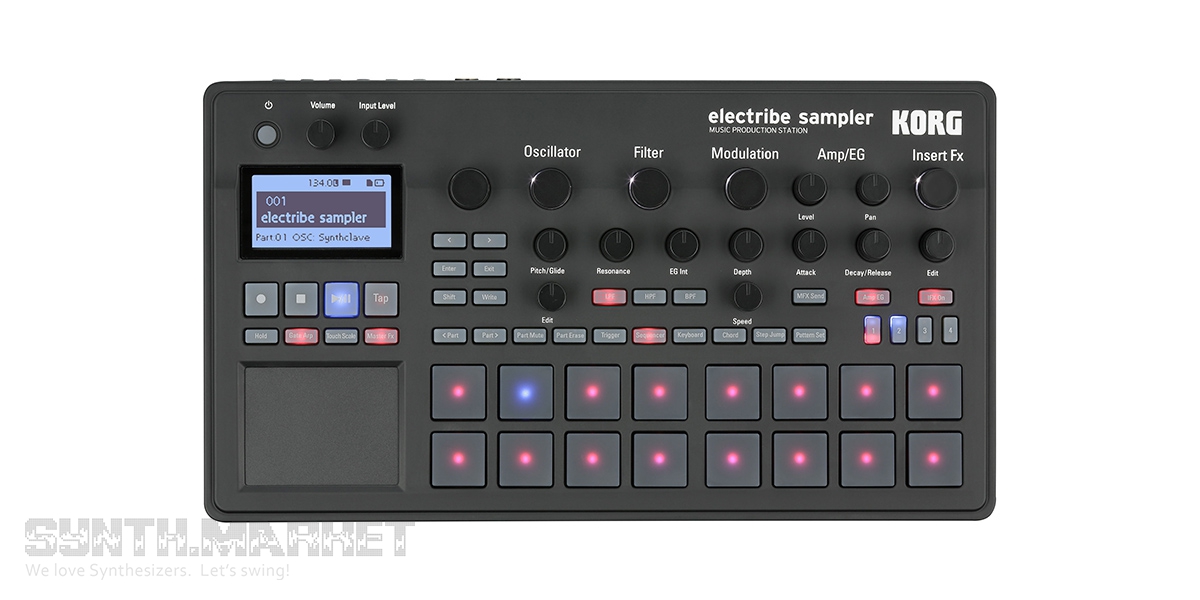
The Korg Electribe Sampler (ES2) is a compact, portable groovebox released in 2015 as a companion to the Electribe 2 (E2) synthesiser. It is housed in a die-cast zinc body finished in a velvety matte black, giving it a distinctly brooding aesthetic compared to the grey Electribe 2. The rubber performance pads, also in black, feel robust and are praised for their responsiveness, while a small X–Y kaoss pad sits on the panel for expressive real-time control.
At its core, the ES2 is a 16-part pattern sequencer and sampler that merges analogue modelling, PCM playback and user sampling into a single, affordable unit. Each of the 16 parts supports its own insert effect, and a shared master effect — controllable via the X–Y pad — provides reverb and further processing across the full mix. Up to 24 notes of pseudo-polyphony are available simultaneously, making it practical for full arrangements within a single device.
Patterns are stored in one of 250 slots and can be up to four bars long. They can be programmed via the pads in real time or entered step-by-step in classic X0X sequencer fashion. Motion recording allows knob movements to be captured and replayed automatically within a pattern, enabling evolving, animated sequences. There is no dedicated song mode or pattern chaining on board, so live performance and creative improvisation are central to the intended workflow.
The oscillator engine offers 16 analogue-modelled waveforms (saw, pulse, triangle, sine — each in single, unison and sync variants — plus four noise types), a live audio input in mono or stereo, a large factory PCM library of drums and instruments, and user sample slots from position 501 up to 999. A notable addition over the Electribe 2 is pre-sliced loop playback: factory loops arrive already divided into up to 64 individually addressable slices, each playable and processable independently, and tempo-synced to any pattern. All PCM samples support reverse playback, with the oscillator Edit knob serving as a bi-polar control that sets the start point and direction in one gesture. Setting the envelope release to maximum causes any sample to play through to its natural end regardless of note length.
Sampling itself is initiated via a shift-and-record shortcut and supports both mono and stereo capture from the mini-jack input, as well as internal resampling of the ES2's own audio output — useful for printing effects permanently onto a sound or bouncing an entire pattern to a loop. Newly recorded samples occupy 16-bit / 48 kHz audio. The device ships with approximately 99 seconds of free sample RAM (roughly 273 seconds if all factory content is deleted), stored on a user-supplied SD card. Samples can also be imported from card as 16- or 24-bit WAV files, and lower sample rates are accepted on import to conserve memory. Each sample can be renamed, trimmed and looped via a numeric edit menu, though there is no waveform display, no crossfade looping and no fine-pitch tuning (only semitone-step adjustment is available).
The filter section offers three classic modes — low-pass, high-pass and band-pass — inherited from the earlier Electribe X series. These are functional but represent a step back compared to the more advanced filter models found in the Electribe 2. The 38 insert effect algorithms shared with the E2 include EQ, filtering, overdrive, delay, flange, chorus, gating, grain shifting and note shifting, among others. Notably, reverb is available only through the master effect.
Connectivity is provided via two full-size audio outputs on the rear, with all other connections — including headphones, MIDI In and MIDI Out — using mini-jack sockets that require Korg's own adapters. There is no MIDI Thru or software Thru. The micro-USB port handles MIDI over USB only and cannot be used for sample transfer; all audio file management takes place via the SD card slot. The unit runs on batteries as well as mains power, making it genuinely portable. A licence for Ableton Live Lite 9 is included, and patterns can be exported as WAV files or in Ableton's native format for further production work in a DAW.
Version 1.1 of the operating system introduced a range of improvements applicable to both the ES2 and the Electribe 2, including smoother track transitions between pattern changes, improved X–Y pad performance, the ability to copy part data between patterns, single-operation export of all patterns, stereo WAV export preserving panning, and various low-level bug fixes. One known remaining issue at the time of review was audible glitching when writing a pattern during playback.
Despite some limitations — most notably the modest sample memory comparable to the decade-older ESX1, the restricted filter selection, the absence of stretch-part functionality and the lack of fine-tuning — the Electribe Sampler was widely regarded as the most versatile and complete Electribe released to that point, offering an impressive balance of synthesis, sampling and performance capability at a competitive price.
Technical Specifications
Oscillators&Sound Sources
- Oscillator types (analogue models): 16 — saw, pulse, triangle, sine (single / unison / sync variants) plus 4 noise types
- Oscillator types (PCM): Large factory library including drums, piano, electric piano, organ, guitar, strings, choir, oriental percussion, TR606 hi-hats, stereo cymbals, tympani
- Sliced loop playback: Yes — factory loops pre-sliced, up to 64 slices per loop; multiple simultaneous slice tracks supported
- Reverse playback: Yes (all PCM samples)
- Sample start-point control: Yes (bi-polar Edit knob; also a modulation destination)
- Audio input as oscillator source: Yes — mono or stereo via mini-jack
Sampling&Sample Management
- User sampling: Yes
- Sampling resolution: 16-bit / 48 kHz
- Sample memory (free as shipped): ~99 seconds
- Sample memory (all factory content deleted): ~273 seconds (~4.5 minutes)
- Total sample RAM: ~24 MB
- User sample slots: 501–999 (499 slots)
- Resampling: Yes (internal audio, with effects)
- Sample import: Yes — 16-bit and 24-bit WAV via SD card; lower sample rates accepted
- Sample editing: Rename, trim (numeric start/end points), loop; no waveform display, no crossfade looping
- Sample tuning: Semitone steps only; no fine-tune
- Sample playback boost: Optional +12 dB
- Stretch parts: Not included
- Multi-sampling: Not supported
Sequencer&Pattern Engine
- Parts: 16
- Polyphony: 24 notes (pseudo-polyphonic)
- Patterns: 250, up to 4 bars each
- Song mode / pattern chaining: None
- Sequencer type: X0X-style step sequencer and real-time pad recording
- Motion recording: Yes
Filters&Effects
- Filters: 3 modes — low-pass, high-pass, band-pass (Electribe X series models)
- Insert effects: 38 algorithms per part (EQ, filtering, overdrive, delay, flange, chorus, gate, grain shift, note shift, and others)
- Master effect: 1 (reverb; shared across all parts; controlled via X–Y pad)
Build&Controls
- Body: Die-cast zinc, matte black or red finish
- Performance pads: 16 velocity-sensitive rubber pads, black
- X–Y pad: Yes (kaoss-style, controls master effect)
- Power: Mains adapter or batteries
Connectivity
- Audio outputs: 2 × full-size jack (stereo)
- Headphone output: 1 × mini-jack
- Audio input: 1 × mini-jack (mono/stereo)
- MIDI In: Mini-jack (adapter required)
- MIDI Out: Mini-jack (adapter required)
- MIDI Thru: None (no hardware Thru, no soft-Thru)
- USB: Micro-USB — MIDI only (no audio or file transfer)
- Storage: SD card (not supplied)
Software&Export
- Pattern export formats: WAV (stereo, preserving panning), Ableton Live native format
- Included software: Ableton Live Lite 9 (licence)