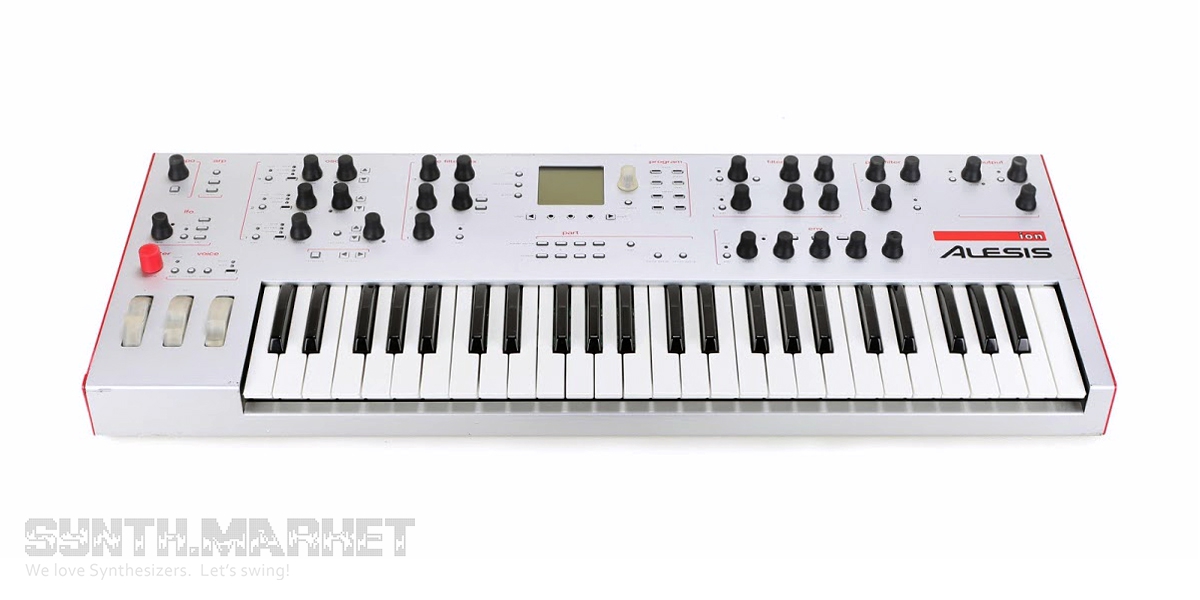
The Alesis Ion represents a significant departure from its predecessor, the Andromeda, being a DSP modelling synthesizer rather than a true analogue instrument. Despite initial surprise at this direction, the Ion has established itself as one of the most convincing virtual analogue recreations available, offering rich, warm tones that challenge even dedicated analogue enthusiasts to dismiss it as merely "cold and digital."
Design & Build
The Ion presents a striking appearance with its Waldorf-reminiscent red and silver color scheme. The spacious control panel features 30 dark, rubbery, high-resolution 360-degree potentiometers that feel excellent to use, though the 70 small buttons feel somewhat cheap by comparison. The completely flat design lacks a raised control panel, which can make viewing the 160x160 LCD display challenging without stooping over the keyboard.
The front panel legending proves rather small, particularly problematic in low-light conditions, though the instrument compensates with numerous useful indicator LEDs. Some LEDs are built into buttons and vary in intensity according to underlying parameter values—for instance, transposing oscillators progressively brightens the Up switch indicator. The three performance wheels are backlit and can be configured to grow brighter with movement, creating an attractive visual effect.
The four-octave keyboard features velocity and release-velocity sensitivity but disappointingly lacks aftertouch (though Mod Wheel 2 can be assigned to transmit aftertouch as a compromise). The keyboard action is quite light and somewhat insubstantial for serious performance work.
Sound Engine Architecture
At the heart of the Ion lies considerable DSP muscle: a 32-bit Motorola Coldfire CPU working in concert with nine Alesis-designed DSP chips (one per voice plus one for effects), delivering a combined 500 MIPS of processing power. This formidable architecture is dedicated primarily to sound quality rather than voice count, resulting in eight-note polyphony and four-part multitimbrality—modest specifications that prioritize sonic excellence over sheer numbers.
Oscillators
Each of the Ion's eight voices contains three oscillators offering continuously variable waveshapes. The square waveform morphs from narrow pulse to full hollow square wave; the sawtooth transitions from positive saw through triangle to negative saw; and the sine wave transforms into a "deformed sine" that introduces higher harmonics. All waveforms are displayed graphically on-screen.
Each oscillator can be transposed in octaves (±3 range), semitones (±7), or fine-tuned in half-cent intervals. The oscillators excel when subtly detuned against each other and offer several distinctive features:
Oscillator Sync: Available in both hard and soft modes. Hard sync functions traditionally, with the synced oscillator resetting its waveforms in line with the master. Soft sync causes the slaved waveform to reverse direction when the master waveform begins its cycle, producing waves without sharp edges and different harmonic mixtures. Oscillator 1 always serves as master, while Oscillator 2 or both Oscillators 2 and 3 can be sync slaves.
FM Implementation: Three algorithms are available—3>2>1 (Oscillator 3 modulates Oscillator 2, which modulates Oscillator 1), 3>1<2 oscillators="" 3="" and="" 2="" modulate="" oscillator="" 1="" or="" 2="">1 (Oscillator 3 plays no FM role). FM can be either linear or exponential, with a dedicated level control for immediate access.
Signal Routing
The oscillators pass through a pre-filter mixer stage along with noise (white or pink), ring modulation (using Oscillators 1 and 2), and external audio input. This mixer determines how much of each audio source routes to each of the two filters per voice, with the default sending equal amounts to both. The external stereo audio input uses a balance control—in its middle setting, the left channel goes entirely to Filter 1 and the right to Filter 2. An additional option routes Filter 1's output into Filter 2 for series cascading.
Filter Section
The Ion's twin filters represent a tour de force, with 17 different types available to each, plus a bypass option:
Classic Emulations:
- 'mg': Four-pole low-pass modeled on the most famous monophonic analogue synth
- 'ob': Two-pole low-pass, band-pass, and high-pass resembling a classic synth expander
- 'rp': Four-pole low-pass from a popular semi-modular synth
- 'tb': Three-pole low-pass (the "little silver bass synth")
- 'jp': Four-pole low-pass from an eight-voice synth with colored buttons
Original Designs:
- Eight-pole low-pass with very steep cutoff
- 8ve dual band-pass (two two-pole filters spaced one octave apart)
- Six-pole band-pass (exaggerated 'ob' band-pass)
- Phase warp (analogue phaser based on eight all-pass filters in series)
- Comb filter 1 (multiple resonant peaks and notches, not harmonically related)
- Comb filter 2 (as above but additionally filtered for warmth)
- Vocal formant 1 ('ah' and 'oo' vowel sounds)
- Vocal formant 2 ('oh' and 'ee' vowel sounds)
- Vocal formant 3 (five-band formant filter)
- Band limit (two-pole high-pass and low-pass in series, with resonance adjusting bandwidth)
Each filter has a dedicated bi-polar envelope amount knob, with the Edit menu providing graphical representation via on-screen sliders showing filter frequency in Hz. Additional options include key-tracking, and Filter 2 features an offset function that ties its frequency to a fixed offset from Filter 1, allowing both to sweep together when Filter 1's cutoff is adjusted.
The filters respond smoothly throughout most of their range, with only maximum resonance settings occasionally proving harsh and digital-sounding. The variety and flexibility allow users to go far beyond simple emulation of classics like Moogs, Oberheims, and Jupiters.
Post-Filter Mixer
Following the filters, the Post-Filter Mixer determines the amount of each filter sent to the output stage and their panning in the stereo field. A "Pre-Filter" signal can be reintroduced at this stage, selectable from any oscillator, ring modulation, noise source, or the entire pre-filter input mix. With dedicated knobs for each mix signal, this section offers extensive creative possibilities.
Modulation System
The Ion's modulation capabilities are exceptional, featuring three envelopes, two LFOs, and separate Sample and Hold as basic sources, with many more available within the modulation matrix.
Modulation Matrix
Accessed via a dedicated button, the matrix provides 12 completely free modulation connections per program. These can dynamically control waveform pitch and shape (for all waves, not just square), filter routing, panning, frequency, mixer settings, effects, and more.
Modulation parameters include source (36 choices plus MIDI controllers 1-119), level, destination (78 options), and an offset parameter that adds a fixed positive or negative offset to the destination value. The matrix is comprehensive enough to rival the classic Oberheim Xpander, including exotic features like a "tracking generator" that remaps modulation sources to produce warped, non-linear outputs—useful for creating unusual pitch variations across the keyboard or rescaling MIDI controllers to activate only after exceeding specific values.
LFOs
Both LFOs offer all waveforms simultaneously in the modulation matrix: sine, triangle, sawtooth, square, plus phase-shifted versions of each. Additionally, totally random modulation sources and sample and hold are available. The Sample and Hold takes a more versatile approach than typical implementations, capable of sampling note velocity, LFO waveforms, MIDI controller numbers, envelopes, and tracking generator output. Parameters include smoothing, S&H rate, reset-on-note, and sync-to-MIDI-clock, all comprehensively programmable.
Envelopes
The Ion's envelope implementation is exceptional—arguably the best available on any synthesizer. The single drawback is having only one set of hardware controls for all three envelopes.
Key features include:
- Independent control over attack, decay, and release slopes with linear or exponential curves (positive or negative)
- Time ranges from 0.5ms to 30 seconds for attack, decay, or release
- Maximum release setting enters Hold mode, sustaining indefinitely
- Five-stage design with additional sustain time allowing gradual decay to nothing or standard ADSR behavior
- Free-run mode passing through entire attack-and-release phase regardless of key-hold duration
- Reset-at-zero or legato mode (carrying on from previous level on new notes)
- Loop capability with various modes, including looping the attack and decay portion while holding a note or forever in free-run mode
Having the pitch/mod envelope freely assignable in combination with the Modulation Matrix allows completely different envelope shapes for each filter and sophisticated tricks like fading signals between filters while performing traditional filter sweeps.
Effects Processing
The effects section proves surprisingly limited given Alesis's history in this field. Each of the four parts has its own modeled Drive effect: Compressor, RMS Limiter, Tube Overdrive, Distortion, Tube Amp, or Fuzz Pedal. These adequately boost and dirty signals but aren't particularly remarkable.
Master effects include: Super Phaser, String Phaser, Theta Flanger, Thru Zero Flanger, Chorus, and Slap Back. Some sound particularly analogue and convincing—especially the flangers—but there's no reverb, and the only pure delay effect (Slap Back) has a maximum time of just 80ms, rendering it useless for echo duties. In multitimbral setups, all Master effects settings refer to part A only; parts B-D have merely a send amount.
Vocoder
A 40-band vocoder is included with a generous selection of tweakable parameters and routing options. It can process the synth's own signals or use the stereo audio input to provide both source and carrier signals. Example patches in the User bank provide excellent starting points, and overall the vocoder performs splendidly.
Performance Features
Arpeggiator
Located at the top left-hand corner, the arpeggiator interface consists of a tempo knob, tap-tempo button with LED indicator, enable and latch buttons. The LCD-based Edit menu offers 32 preset patterns with settings for arpeggio length, range, span (above, below, or above and below base notes), and note order.
Additional Performance Tools
- Dedicated buttons for Unison mode and mono/polyphonic operation
- Comprehensive portamento settings: portamento or glissando with fixed or scaled rate
- Portamento can work on all notes or just legato-played notes
- Pitch wheel can operate on all notes or just held notes
- "Analogue drift" feature makes the perfectly-tuned digital synth behave like temperamental vintage circuits, capable of recreating extreme detuning effects
Sound & Programming
Factory Sounds
With four color-coded banks (Red, Green, Blue, Yellow) containing 512 patches total, the Ion provides extensive auditioning material. All banks are user-rewritable despite Yellow being designated the "user bank." Patch locations follow similar organization in each bank, starting with synth bass and leads and ending with sound effects and percussion.
The Ion sounds notably fat and "American" compared to other modeled analogues, with bass ranging from warm to cutting to rival the best analogue monosynths. Alesis has clearly invested significant effort in minimizing digital artifacts, resulting in one of the most organic-sounding DSP-based instruments available. The factory sounds are generally good, but the instrument truly shines when programming original material.
Multitimbral Operation
For multitimbral play, 64 Setup locations reference up to four patches, each with individual MIDI channel, output routing and panning, high and low key ranges, effects level, transpose settings, and mod wheel response. Each part (A-D) can be enabled or disabled via dedicated front-panel buttons, with a second row denoting which part is active for editing. Careful panning allows routing each part to its own output.
MIDI Implementation
All front-panel knobs transmit MIDI NRPNs (Non-Registered Parameter Numbers) for sequencer recording. While more editable than system-exclusive data, this creates challenges when editing controllers in sequencers. Turning a single knob generates four MIDI controllers: parameter identifier in LSB (CC98) and MSB (CC99) format, plus data entry as LSB (CC38) and MSB (CC6). This nested structure becomes messy when multiple knobs are turned simultaneously, though it does allow greater resolution than standard MIDI controllers' 0-127 range. The modulation matrix can remap specific MIDI controllers to desired functions for more editable remote control.
Audio Connectivity
The rear panel features:
- Stereo audio outputs (24-bit balanced 1/4" TRS)
- Two additional outputs (24-bit balanced 1/4" TRS)
- Stereo audio inputs (24-bit balanced 1/4" TRS)
- 1/4" TRS headphone jack
- Control and sustain pedal inputs (assignable expression pedal, sustain pedal)
- MIDI In, Out, and Thru
- Standard IEC power connector
Performance & Reliability
The review unit running OS v1.0 exhibited remarkably few problems. Occasional "crack" sounds when playing some patches may be caused by free-running oscillator behavior (a future OS upgrade should add oscillator phase reset options). The synth crashed when playing back excessive controller data recorded in Cubase, but Alesis quickly identified and planned to fix this bug. Beyond these niggles and initial confusion with envelope looping, the Ion performed admirably.
Conclusion
The Alesis Ion raises the bar for modeled analogue instruments with rich, warm tones, varied filters, versatile signal routing, powerful modulation matrix, and exceptional envelopes that form a synthesizer even analogue purists cannot dismiss as cold and digital. The user interface delights and frustrates in equal measure—excellent knobs but cheap-feeling buttons, beautiful backlit wheels but a light keyboard lacking aftertouch, and a display positioned at an awkward angle.
Sound quality ultimately defines the instrument's worth, and despite surprisingly limited effects implementation, the Ion delivers beautifully in the sonic department. Its convincing recreations of Moog, Oberheim, Roland, and ARP sounds, combined with exotic vocal textures and unique comb and phasing filters, offer tonal tinkering potential exceeding immediate rivals. For those prioritizing sound and flexibility over polyphony and effects, the Ion deserves serious consideration as one of the best virtual analogue recreations yet achieved.
Technical Specifications
Sound Engine
- Sound Generation: Alesis proprietary DSP Analog Modeling
- Processing Power: 500 MIPS total
- 32-bit Motorola Coldfire main CPU
- 9 Alesis-designed DSP chips (1 per voice + 1 for effects)
- Polyphony: 8 voices
- Multitimbrality: 4 parts
- Architecture per Voice:
- 3 oscillators with continuously variable waveshapes
- 2 multi-mode filters (17 types each + bypass)
- 3 envelope generators (5-stage ADSSR)
- 2 LFOs with multiple waveforms
- Programmable effects send
- Modulation matrix
Oscillators
- Waveforms: Square (narrow pulse to full square), Sawtooth (positive through triangle to negative), Sine (to deformed sine)
- Pitch Control:
- Octave transpose: ±3 octaves
- Semitone transpose: ±7 semitones
- Fine tune: half-cent intervals
- Special Features:
- Hard and soft oscillator sync
- FM synthesis (3 algorithms: 3>2>1, 3>1<2, 2>1)
- Linear or exponential FM
- Ring modulation (Oscillators 1 and 2)
Filters
- Configuration: 2 filters per voice
- Filter Types (17 total per filter):
- 'mg' four-pole low-pass
- 'ob' two-pole low-pass, band-pass, high-pass
- 'rp' four-pole low-pass
- 'tb' three-pole low-pass
- 'jp' four-pole low-pass
- Eight-pole low-pass
- 8ve dual band-pass
- Six-pole band-pass
- Phase warp (8 all-pass filters in series)
- Comb filter 1 & 2
- Vocal formant 1, 2, & 3
- Band limit
- Bypass
- Filter Routing: Parallel or series (Filter 1 into Filter 2)
- Filter Controls: Dedicated bi-polar envelope amount knob per filter
- Additional Features: Key-tracking, Filter 2 offset function
Modulation
- Modulation Matrix: 12 free slots per program
- Modulation Sources: 36 sources + MIDI controllers 1-119
- Modulation Destinations: 78 destinations
- Special Features: Tracking generator for non-linear modulation mapping
- LFO Waveforms: Sine, triangle, sawtooth, square (plus phase-shifted versions), random, sample & hold
- LFO Features: Rate, reset-on-note, sync-to-MIDI-clock
- Sample & Hold: Can sample velocity, LFOs, MIDI controllers, envelopes, tracking generator; includes smoothing parameter
- Envelope Specifications:
- 5-stage (ADSSR: Attack, Decay, Sustain level, Sustain time, Release)
- Time range: 0.5ms to 30 seconds
- Slope control: Linear or exponential curves (positive or negative) for attack, decay, release
- Modes: Standard, free-run, legato, loop, hold
- Independent curve shaping per stage
Effects
- Drive Effects: 6 types per part (Compressor, RMS Limiter, Tube Overdrive, Distortion, Tube Amp, Fuzz Pedal)
- Master Effects: Super Phaser, String Phaser, Theta Flanger, Thru Zero Flanger, Chorus, Slap Back (max 80ms)
- Vocoder: 40-band with extensive parameters and routing
- Effects Architecture: 4 Drive effects (1 per part) + Master effects (shared, part A settings only)
Memory
- Program Memory: 512 preset programs (all user-rewritable)
- Banks: 4 color-coded banks (Red, Green, Blue, Yellow)
- Multitimbral Setups: 64 setup locations (up to 4 patches each)
Audio Performance
- Signal-to-Noise Ratio: >95 dB A-weighted (External In to Main or Aux Out)
- THD+N: <0.005% (External In to Main or Aux Out)
- Frequency Response: 20-20kHz ±0.20dB (External In to Main or Aux Out)
- Bit Depth: 24-bit (all audio inputs and outputs)
Audio Inputs
- Input Connectors: 2 balanced 1/4" TRS jacks (stereo)
- Maximum Input Level: +5.2dBu (1.41VRMS) = 0dBFS
- Input Impedance: 10kΩ
Audio Outputs
- Output Connectors: 4 impedance-balanced 1/4" TRS jacks (Main L/R, Aux L/R)
- Headphone Output: 1/4" TRS jack
- Maximum Output Level: +18dBu (6.17VRMS) = 0dBFS
- Output Impedance: 1kΩ
Control Interface
- Display: 160x160 pixel LCD with graphics
- Rotary Controls: 30 360-degree high-resolution potentiometers
- Buttons: 70 buttons with LED indicators (some with variable intensity)
- Performance Wheels: 3 assignable wheels (2 mod wheels, 1 pitch wheel) with backlighting
- Data Entry: Notched clear plastic knob plus soft buttons
- Keyboard: 49 keys (4 octaves)
- Velocity sensitive
- Release velocity sensitive
- No aftertouch
- Pedal Inputs: Assignable expression pedal jack, sustain pedal jack
MIDI
- Connections: MIDI In, Out, Thru
- Implementation: Full MIDI specification
- Data Transmission: NRPNs (Non-Registered Parameter Numbers) for all front-panel controls
- Controllers: CCs 98, 99 (parameter ID LSB/MSB), 38, 6 (data entry LSB/MSB)
Performance Features
- Arpeggiator: 32 preset patterns with tempo knob, tap tempo, latch
- Portamento: Fixed or scaled rate, portamento or glissando, all notes or legato
- Voice Modes: Unison, mono/poly
- Special Features: Analogue drift simulation, pitch wheel mode (all notes or held notes)
- Transposition: Per-part transpose settings in multitimbral mode
- Key Ranges: Programmable high/low key ranges per part
Physical Specifications
- Dimensions (W×H×D): 33.0" × 3.75" × 13.0" (838.2 × 95.25 × 330.2mm)
- Weight: 20 lbs (9 kg)
- Color Scheme: Red and silver
Power
- Power Consumption: 12 watts maximum
- Input Voltage: 100-240VAC, 50-60Hz
- Power Connector: Standard IEC "kettle" connector