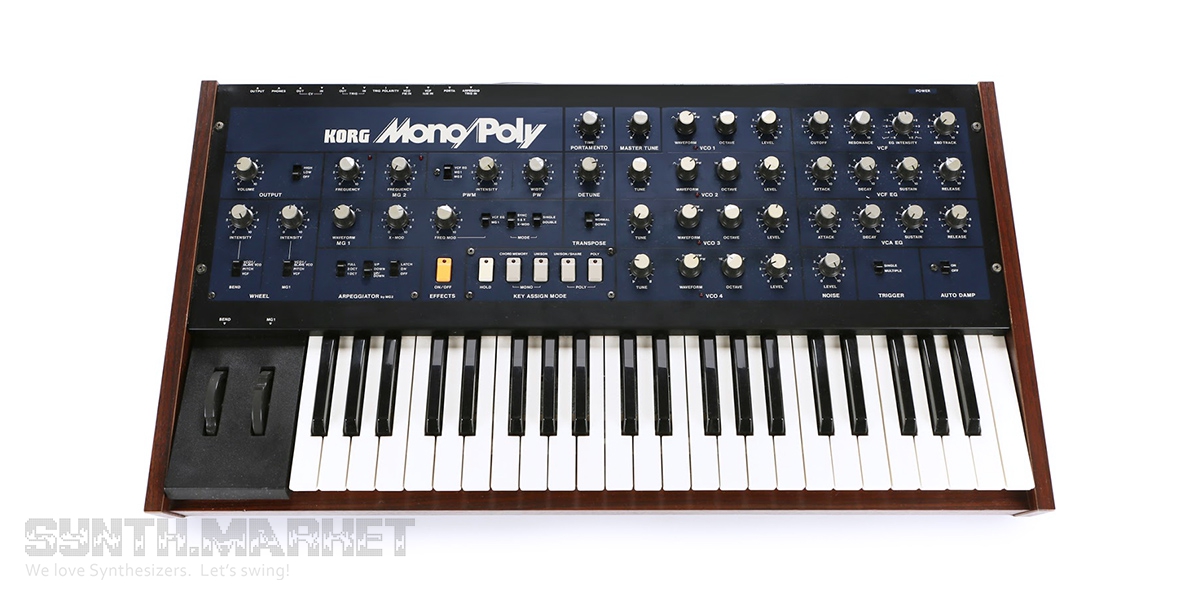
The Korg Mono/Poly represented in 1981-82 an innovative approach to synthesizer design, offering genuine dual-mode operation as both a monophonic and polyphonic instrument at a very competitive price point. This versatile synthesizer successfully bridged the gap between high-performance monophonic synthesis and accessible polyphonic capability, incorporating several clever design solutions that genuinely enhance its musical performance.
Build Quality and Construction
The Mono/Poly showcases the high manufacturing standards typical of Japanese instruments of this era. The casework features dark wood veneer on the sides and front panel, with a plain wooden base board providing a solid foundation. The main control panel consists of black anodised formed aluminium with blue block overlays for section identification and white graphics for clear labeling. While the keyboard construction could be described as somewhat plasticky, the key action itself is excellent — positive and responsive with precisely the right amount of key dip. The control knobs are functional rather than exceptional, but the overall instrument projects an air of quality and thoughtful construction.
Oscillator Architecture and Key Assignment
At the heart of the Mono/Poly lie four voltage controlled oscillators serving as the main tone generators. The sophisticated control circuitry determines whether these oscillators operate in monophonic or polyphonic mode through a clever assignment system. The mixed signal from all oscillators and the noise source passes through a single voltage controlled filter and voltage controlled amplifier—this shared architecture represents the primary compromise inherent in the pseudo-polyphonic design, but one that Korg has addressed with intelligent control features.
The key assignment system offers five distinct modes controlled by conveniently positioned push-button momentaries located one and a half inches above the keyboard. In Poly mode, the instrument assigns notes intelligently: the first note played routes to VCO 1, the second to VCO 2 (or back to VCO 1 if the first key has been released), continuing this pattern. When four notes are held and a fifth is triggered, VCO 1 is reassigned to the new note. In Unison mode, the control voltage from the last note played routes to all four oscillators simultaneously, creating a thick, powerful monophonic sound.
The Chord/Share mode (previously seen on the Roland JP-4) operates monophonically with all oscillators in parallel when playing single notes. When two notes are played, VCOs 1 and 2 handle one note while VCOs 3 and 4 take the other; three-note playing assigns one VCO per note with the fourth idling. This intelligent resource allocation maximizes the instrument's capabilities.
Chord Memory mode (reminiscent of features found on Oberheim's OB-X, OB-XS, and OB-Xa) allows players to program harmonic relationships. By playing a chord — say a major seventh — and activating Chord Memory, every subsequent single note automatically generates that same intervallic relationship across the oscillators. This transforms the instrument into a monophonic synthesizer with oscillators set at predetermined intervals, far more convenient than manually tuning oscillators to different pitches.
Polyphonic Performance Solutions
Korg's engineers recognized the inherent challenges of pseudo-polyphonic architecture and implemented thoughtful solutions. The shared VCF and VCA create potential issues when holding one note while playing and releasing another, particularly with longer release times. The Mono/Poly addresses these challenges through two key features:
The single/multiple trigger switch manages filter envelope behavior. In multiple mode, the filter envelope retriggers with every new note, affecting both new and held notes. In single mode, new trigger pulses only generate after the keyboard clears, preventing the new note from affecting the filter envelope of sustained notes.
The Auto-Damp switch solves the problem of oscillator gating to the VCF. Without this feature, releasing a second key while holding another would result in abrupt cutoff, even with long release times set. Auto-Damp sustains the released note until the first key releases, allowing both notes to fade naturally according to the VCA envelope release time. While not a perfect solution, this feature significantly enhances polyphonic performance across various playing styles.
The Mono/Poly also offers polyphonic portamento, providing a slew limiter on the control voltage line to all oscillators for smooth gliding between notes in polyphonic mode.
Sound Generation and Modulation
Each of the four oscillators offers comprehensive waveform selection: triangle, ramp, pulse (with variable width), and pulse width modulated waveforms, available at 16', 8', 4', and 2' pitches. The master tune control provides ±1 semitone adjustment affecting all oscillators, while VCOs 2, 3, and 4 feature individual fine-tune controls (also ±1 semitone). A master detune control shifts the frequencies of VCOs 2 and 4, enabling rich ensemble effects. Each oscillator includes its own level control, and the sound generation network is completed by a dedicated noise source.
The voltage controlled filter employs a steep 24dB/octave low-pass design capable of self-oscillation. It features keyboard tracking and both positive and negative envelope modulation facilities. Both the VCF and VCA have dedicated ADSR envelope generators for precise articulation control.
The modulation system incorporates two low frequency oscillators (termed "modulation generators" by Korg). The first LFO provides sawtooth, ramp up, ramp down, and square waves, controllable via the performance wheel to modulate oscillator pitch, filter cutoff, and oscillator pulse width. The second LFO can control pulse width or serve as the clock source for the arpeggiator.
A particularly impressive feature is the comprehensive cross-modulation and synchronization section, neatly arranged in the center of the control panel. These effects can be preset and instantly activated via momentary buttons, providing sophisticated sound-shaping capabilities that significantly expand the instrument's sonic palette.
Arpeggiator
The Mono/Poly includes a capable arpeggiator, an increasingly popular feature in synthesizers of this era. Players can hold a chord (using the latch feature if desired), and the control circuitry automatically plays each note in sequence at a rate determined by the second LFO's speed. The arpeggio can automatically expand across the entire keyboard width, with three available patterns: Up, Up/Down, and Down, providing versatile rhythmic and melodic possibilities.
Performance Controls and Interface
The pitch-bend wheel features a center detent for returning to the initial tuned position—crucial for maintaining accurate pitch. However, the review notes that this detent is somewhat weak and would benefit from strengthening in production models.
The rear panel provides comprehensive connectivity: audio output, headphone output (delivering good, loud monitoring), control voltage and gate inputs and outputs (notably using the volt/octave standard rather than Korg's previous Hz/volt system), VCO FM input, VCF FM input (both for pedal control), portamento footswitch input, and arpeggio trigger input (useful for synchronization with drum machines). This extensive interface capability makes the Mono/Poly highly integrable with other equipment.
Technical Specifications
Keyboard
- Keys: 44-note, F to C
- Action: Positive action with appropriate key dip
- Construction: Plastic construction
Oscillators
- Number: 4 voltage controlled oscillators (VCOs)
- Waveforms: Triangle, Ramp, Pulse (variable width), Pulse Width Modulated
- Octave Range: 16', 8', 4', 2' (4 octave range per oscillator)
- Tuning Controls:
- Master tune: ±1 semitone (affects all VCOs)
- Individual fine tune for VCOs 2, 3, 4: ±1 semitone each
- Master detune: Shifts VCOs 2 and 4
- Level: Individual level control per oscillator
Filter
- Type: Voltage Controlled Filter (VCF)
- Slope: 24dB/octave low-pass
- Features:
- Self-oscillation capable
- Keyboard tracking
- Positive and negative envelope modulation
- Envelope: Dedicated ADSR
Amplifier
- Type: Voltage Controlled Amplifier (VCA)
- Envelope: Dedicated ADSR
Noise Source
- Integrated noise generator with level control
LFOs (Modulation Generators)
- Number: 2 Low Frequency Oscillators
- LFO 1:
- Waveforms: Sawtooth, Ramp Up, Ramp Down, Square
- Destinations: Oscillator pitch (via performance wheel), Filter, Oscillator pulse width
- LFO 2:
- Destinations: Pulse width control, Arpeggiator clock
Key Assignment Modes
- Poly: Intelligent note assignment to VCOs 1-4
- Unison: All four VCOs track last note played
- Chord/Share: Dynamic VCO allocation based on number of notes played
- Chord Memory: Stores harmonic intervals for monophonic chord playing
- Hold: Sustain function
Trigger Modes
- Single Trigger: Filter envelope triggers only after keyboard cleared
- Multiple Trigger: Filter envelope retriggers with each new note
Special Features
- Auto-Damp: Sustains released notes until held notes release
- Polyphonic Portamento: Slew limiter on CV line to all oscillators
- Cross Modulation Section: Preset modulation and synchronization effects with momentary button activation
- Arpeggiator:
- Patterns: Up, Up/Down, Down
- Speed: Controlled by LFO 2
- Keyboard expansion: Automatic across full keyboard range
- Latch function available
Controls
- Knobs: 41 control knobs
- Switches: 14 slide switches
- Buttons: 6 push-button momentaries with LED indicators
- Performance Controls: 2 wheels (pitch bend with center detent, modulation)
Connections (Rear Panel)
- Audio:
- Audio Output (1/4" jack)
- Headphone Output (1/4" jack, high output level)
- CV/Gate (Volt/Octave Standard):
- Control Voltage Input
- Control Voltage Output
- Gate Input
- Gate Output
- Modulation:
- VCO FM Input (for pedal control)
- VCF FM Input (for pedal control)
- Control:
- Portamento (footswitch input)
- Arpeggio TRIG Input (for external clock/drum machine sync)
Total Jack Sockets: 10
Physical Construction
- Case Material:
- Sides and front: Dark wood veneer
- Base: Plain wood
- Control panel: Black anodised formed aluminium
- Panel overlay: Blue block identification sections
- Graphics: White lettering
- Control panel: Hinged design for access to internal components
Power
- Mains power with ON/OFF rocker switch